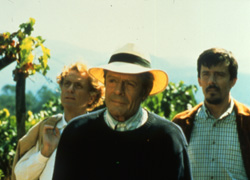
This film is built on long takes, many shot from within a car. The movement of the vehicle that bears the camera as well as the actors gives rise to pans, tracking and trucking shots, and wipes and iris-ins relative to dark areas of the passing environs. In particular, the recession of scenery seen through the rear window sets a contemplative, nostalgic tone. These cinematic gestures are teased out of simple stationary shot set-ups in a way that seems both effortless and miraculous.
Voyage is, by normal standards, exceedingly dialog-driven. Most of this dialog relates events from the pasts of the car's occupants, director Manoel and cast- and crewmembers of one of his films. (This sort of cinema-reflexivity appears to be typical of de Oliveira's work.) Stops along the way trigger memories of youth and familial lore, all of which is related strictly via dialog set against shots based in the present.
If the relationship between the film's visuals and its dialog is thus somewhat oblique, so is the use of non-melodic music. Instead of contextualizing the reminiscences or modulating our emotional responses, it adds its own layer, a moody, contrapuntal soundscape.
De Oliveira almost seems to underplay all those elements of the film that would commonly be thought of as "cinematic" while foregrounding the literary/theatrical. Yet one senses his assurance that, in fact, this is something that cinema can do, and that artfully doing so will bring out some of its rarely-appreciated tendencies.
Voyage to the Beginning of the World isn't much like any other film I've seen, but earlier works in de Oliveira's filmography show some of the stepping stones he traversed on the way to this mature personal style.
His first feature, 1942's Aniki Bóbó, is a delightful exemplar of the sort of European lyrical realism typical of Vigo or Renoir. The story centers on a group of schoolboys as they jockey for a girl's affections and negotiate the moral complexities of a grown-up world. Despite its focus on children, this film was taken as a political critique and de Oliveira found himself unable to make another feature for 20 years, by which time a next generation of directors were exerting their influence on the European film scene.
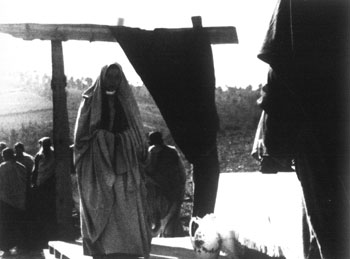 Rite of Spring (Acto de Primavera), from 1963, shows a reënactment of the Passion of Jesus as staged annually in a small Portuguese village. It isn't really a documentary, as this particular staging was for the benefit of de Oliveira's camera. In fact, the film's first section reveals the cinematic apparatus at work with de Oliveira and crew preparing to shoot. Interspersed therein is a poetic montage of "everyday" village life, culminating in the appearance of Jesus, the start of the "play", as a fluid continuance of life in the village. Here we see the emergence of several themes and concerns that recur throughout de Oliveira's work.
After the crucifixion, the film takes another turn, this one abrupt. We are wrenched fully back into the present, where we are confronted with images of all the horrors of modernity: war footage and the like. Two years later Buñuel would end his Simon of the Desert in similar fashion.
Parallels with Buñuel are even more apparent in Past and Present (O Passado o e Presente) (1972). A well-to-do woman despises her current husband while idolizing her late first husband. When, through giddily improbable plot machinations, it turns out her first husband remains alive, and after husband #2 has put himself out of his misery, she scorns #1 and comes to worship her truly deceased second husband. Surrounding her are a group of friends whose marital entanglements themselves make a mockery of the institution. All this is presented matter-of-factly as an almost inevitable bourgeois pathology.