Manoel de Oliveira, Part 2
Posted August 27, 2008 at 6:53pm by Carl Martin
Manoel de Oliveira, Part 1
While his previous two films are based on plays, de Oliveira doesn't fully embrace a theatrical aesthetic, reminiscent perhaps of late Dreyer, until 1975's Benilde or the Virgin Mother (Benilde ou a Virgem Mãe). The ambiguous story of a pious but somnambulant girl who becomes mysteriously pregnant, and the reactions of those close to her, is related in three explicit acts, set on three distinct interior sets. The camera hardly moves (though when it does, it has great significance). On the soundtrack, a constant howling noise--stormy weather not quite drowning out a transient's anguished cries--is perhaps a precursor to Voyage's atonal score. The performances are stripped of nearly all emotional affect, as in Bresson.
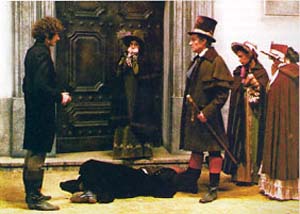 In Doomed Love aka Ill-Fated Love (Amor de Perdição) (1979), the source material is a novel rather than a play. Here the staging is somewhat less confined than in Benilde, with its three sets. But camera movement is just as limited, the action comprising a
series of tableaux, and the narrative unfolds almost entirely via words: dialog and, as inherited from its literary source, narration in the form of voice-over (sometimes reading aloud documents seen on screen). Very little of the original story is left out of this 4+ hour adaptation. But de Oliveira's apparent slavish respect for the medium and material of his sources doesn't preclude certain playful manipulations made possible only by the translation to cinema. For example, the narration is rendered in two different voices, and sometimes delivers characters' lines for them, creating a meta-dialog between the various types of speech in the film.
In Doomed Love aka Ill-Fated Love (Amor de Perdição) (1979), the source material is a novel rather than a play. Here the staging is somewhat less confined than in Benilde, with its three sets. But camera movement is just as limited, the action comprising a
series of tableaux, and the narrative unfolds almost entirely via words: dialog and, as inherited from its literary source, narration in the form of voice-over (sometimes reading aloud documents seen on screen). Very little of the original story is left out of this 4+ hour adaptation. But de Oliveira's apparent slavish respect for the medium and material of his sources doesn't preclude certain playful manipulations made possible only by the translation to cinema. For example, the narration is rendered in two different voices, and sometimes delivers characters' lines for them, creating a meta-dialog between the various types of speech in the film.
These meta-dialogs between the elements of his cinema--image, word, gesture, music, sound, etc.--are always rigorously developed. De Oliveira starts out from a Bazinian conception of adaptation, allowing the characteristic
artificialities of the source medium to dominate. But the very fact that he has filmed them makes them cinematic. And his deft development, in the cinematic domain, of these elements convinces us of this as well.
The story of Doomed Love concerns a well-bred but rebellious student, Simão, whose love for a neighbor girl is thwarted, ostensibly by a family feud. Another girl of lower birth falls for Simão, but class differences and loyalty keep her from being more than a maid to him. What emerges is a tragic sense that the great loves portrayed in the film are simply unattainable in this social-psychological milieu, just as in Buñuel's The Exterminating Angel it is impossible for the party guests to leave the room, no matter how eminently possible it may appear.
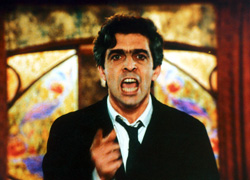 My Case (Mon cas) (1986) takes its theatrical material, a one-act play, and sets it in a literally theatrical space. As in Rite of Spring, we initially see de Oliveira and crew in front of the stage, preparing to start shooting. The curtain parts, but before the play can begin, an interloper who has snuck in from the outside world strides onstage to talk about his own problems. Before we hear much of these, the stage manager comes on to try to usher off the uninvited guest, complaining that his job is now in danger. He is then followed by an actress who attempts to get the play proper off the ground before joining in the argument, which soon attracts the attention of the playwright and a member of the audience as well, all trying to make their own "cases".
This collision between the internal, external, and social aspects of the medium is at once typical de Oliveira, and yet too exclusively theatrical. But it is only the beginning. The curtain closes and opens onto a second "repetition" of the same play, this time in black and white, sped up, and with projector noise on the soundtrack: a crude suggestion of early cinema. A voiceover intones variations on a phrase about death, birth, and inevitability. Is this a parable of the birth of cinema from theatrical origins? The action reboots once more, again in color, but with all the lines played backwards, unintelligibly. A man walks onstage, sets up an apparatus, and projects images of war and strife, similar to those that close Rite of Spring, onto the back wall. Suddenly the pettiness of the bickering personages is made clear. This repetition closes on an image of Picasso's Guernica.
Next, we move to a staging of the biblical story of Job. He sits in squalor, riddled with pustules, and curses the day he was born. Three friends arrive and test his faith, which is strong. The last tableau shows Job again, now recovered and prospering, in an ideal classical setting, while nymphlike creatures prance about, tossing confetti. We dolly in to a portrait of the Mona Lisa, which then appears on a monitor as we find ourselves situated back in the audience with the crew.
This film probably requires more Good Book-learnin' than I possess to appreciate at all its levels. However, as a cinematic deconstruction it is quite radical, and I'm at a loss to cite another director whose work it bears any deep resemblance to. Yet we are still far from the more restrained stylistics of Journey to the Beginning of the World. So far its been a fascinating cinematic journey. The entire PFA series is listed here.