Saturday, September 12
Where better to start than Oddball Films' show Film on Film: Films About Filmmaking, which uses the name of our organization in a different but just as valid sense? To fully understand the poetics of film requires a familiarity with the processes and techniques of the medium. This program comprises both documentaries and how-tos on filmmaking and films that typify the various approaches in question. A highlight of the program (to be honest the only one I can say assuredly that I've seen) is Frank Mouris's Frank Film, an amazing autobiographical audiovisual collage-barrage like nothing else I've seen. Also promised is a chance to participate in the making of a 16mm film on the spot. I'd love to hear how that turns out, if anyone in attendance cares to comment.
The Stanford's Hitchcock series features Rebecca and Shadow of a Doubt. I saw the latter film a decade or so ago and can't recollect any specifics, and would love to revisit it when next it plays a nearer venue. Of Rebecca, on the other hand, I had a second viewing recently as part of the PFA's wonderful Into the Vortex series, which confirmed it as one of my favorite 'cocks. Perhaps due to David O. Selznick's influence, the usual man-of-action histrionics are relegated to the last couple reels, and the bulk of film deals in atmospherics. Laurence Olivier skulks about his gothic mansion romantically, enigmatically, torturedly, as only he can. Judith Anderson sets the standard for creepy hired help, and Joan Fontaine is just luminous. This double bill plays through Monday.
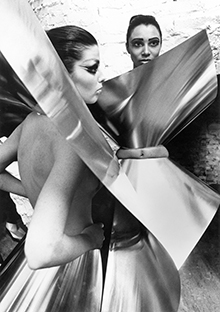
At the PFA: The October Man, which I've not seen, but given its inclusion in the so-far excellent British Crime Film series, warrants a nod, and William Klein's fashion satire Who Are You, Polly Maggoo?, for which the following image cribbed shamelessly from the PFA site should serve as recommendation enough:
And speaking of British crime films, the Castro features Carol Reed's fantastic The Third Man, which has a memorable theme song, incredible photography, and Orson Welles. What more you want? Stick around and catch Brighton Rock while you're at it.
In Nicholas Ray's Bigger Than Life (playing at the Yerba Buena, also Sunday), mild-mannered teacher James Mason's cortisone (!) habit induces vertiginously escalating delusions of grandeur whose culmination finds him, with murder in his eyes, screaming "God was wrong!" with such bluster and conviction that I could (were I given to such thinking) imagine God himself humbly standing corrected.
Sunday, September 13
PFA calendar perusers be warned: I've just been notified that the screening of William Klein's Pan-African Cultural Festival, scheduled to be shown in 35mm, has been authorized to screen only in a newly-reëdited, half-hour shorter, video version. After the visually resplendent Polly Maggoo this is a shame, to be sure.
In the Castro's cyclically arranged British series, Brighton Rock (which I'll see when it hits the PFA next week) is now paired with the most delightful It Always Rains on Sunday, in which the harboring of an escaped criminal by an old flame is just one of many story threads concerning the small-time hoods and everyday people of an unglamorous London neighborhood. Everyone has an angle, a heart, a story, and humanity.
Monday, September 14
Into the revolving Castro lineup falls the relatively late Michael Powell work Peeping Tom, made after the dissolution of his partnership with Emeric Pressburger. Karlheinz Böhm, later to be found in several Fassbinder films, here plays a camera assistant who in his off-time makes his own films in which unwilling females become short-lived movie stars. In the lineage of films offering commentary on the perverse voyeurism of cinema, this one falls somewhere between Rear Window and Man Bites Dog. I've seen Tom but once, years ago, and it's certainly ripe for another viewing. It might have to come via my own print, which I believe is a shorter cut. I'm sure the Castro will be showing the unexpurgated version.
Tuesday, September 15
Your regular tout, Brecht Andersch, recently had the pleasure of projecting Shirley Clarke's Portrait of Jason at MOMA, and took the time to share his enthusiasm for the film on that venue's blog, so I see no reason to duplicate his efforts. Plus, I haven't seen it, but I will... at the PFA.
The Stanford's Hitchcocks the next few days will be the serviceable if not masterful crime procedural Dial "M" for Murder, which is probably best seen in 3-D (as it is shown at the Castro every so often), even if its director wasn't too into the process, and the really-quite-good Strangers on a Train, which features a wonderful Robert Walker, whose mother issues drive him to concoct a scheme for the "perfect murder", into which Farley Granger will be dragged against his will. I tend to prefer those Hitchcocks in which he breaks his usual mold and by working outside his comfort zone comes up with delightful, inspired surprises. This is not such a film, but is a good fit for him thematically and has great set pieces and one of my favorite sight gags (the spectators at the tennis match), which might have inspired Chaplin's critique of Cinemascope six years later in A King in New York.
I haven't seen The Fallen Idol, but it runs the next two days at the Castro and isn't part of the PFA's series, so you could do worse....
Wednesday, September 16
We come full circle at the Castro, with The Third Man back on the docket. I was late for work earlier and gave it short shrift, so I'll take this occasion to dig into my memory and emphasize the many iconic shots (like Welles lighting his cancer stick in a dark doorway) and the high-contrast chiaroscuro glory of rain-slicked night-shrouded urbanity. And the sewers! Perfection!
El Rio plays host to the MadCat-sponsored Movies Under the Stars, a presentation of shorts, mostly from the last few years, and therefore all the more notably, mostly in 16mm (one of them anamorphic!) I've seen only one, Kerry Laitala's Spectrology, which, while not my favorite of her work, does have a certain cinematic self-consciousness about it that I like.
Thursday, September 17
Oh no! Noir is back at the Roxie for 12 not-quite contiguous days, this time all in 35mm! I'm notoriously bad at remembering the titles of noirs, and have been known to watch the same one three or four times without realizing until it starts that yes, I've been here before. So I'm going to cop out and simply say that I'm sure most of these are worthy of your time and money, rather than go through them individually. For the most part.
I always regretted missing Truffaut's The Wild Child when it played back at the old UC Theatre (Those were the days, my friend/ We thought they'd never end/ But they did.) I caught it at last in its recent re-release, and it might be my favorite of François's. Measured and austere, positively Bressonian, lovely noir-et-blanc photography by the great Nestor Almendros. We admire the teacher's efforts to civilize l'enfant sauvage, yet we are fascinated by the child's feral state, and every breakthrough and setback is heartbreaking.