SFIFF 2010 Approacheth
Posted April 10, 2010 at 3:28am by Carl Martin
It's April, and the S.F. International Film Festival rears its head once more. Those wondering which programs will be projected via the divine medium of 35mm celluloid (ok, polyester, to be precise) need look no further than our Film Calendar. In fact, here's a version showing only festival screenings.
This year's crop of revivals is a bit modest compared to the last, and for the film purists somewhat disheartening. Let's start from the bottom and work our way up.
Firstly, Ang Lee's Ride With the Devil will be shown in a director's cut, but digitally. 'Nuff said.
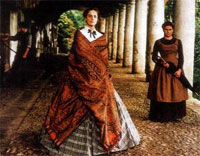 Luchino Visconti's Senso has been restored before, in a version I was privileged to see at the PFA in 2004, and I only wish I could summon a recollection of it! For it has been "restored" once again, this time digitally. Others to whom I've spoken regarding the former version have extolled its visual qualities, and its running time indicates that no additional footage has been incorporated into this new version, so one wonders what the point was of re-restoring it, digitally or otherwise.
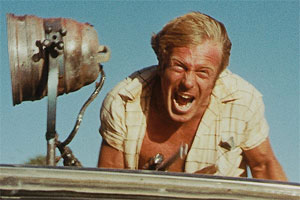 Readers may remember last year's release of the documentary Not Quite Hollywood: The Wild, Untold Story of Ozploitation! I for one did not watch it, stick in the mud that I am, prefering to lament that the Australian exploitation films in question were not themselves being shown. One of these, Wake in Fright (director: Ted Kotcheff (Weekend at Bernie's (!))), is now seeing the light of day, its negative having recently surfaced and narrowly avoided destruction in a Pittsburgh vault's "dump bin". The bad news: it was found that "significant colour fade and emulsion scratching were too severe to rejuvenate via photochemical means." It is of course the view of FOFF that such degradation, unfortunate though it is, is less destructive of a film's essential character than digitization. Nevertheless, that is what happened. Wake in Fright will be seen in a digital restoration (projected in 35mm), and so be it. Curiosity will most likely demand my attendance, all the same.
Satyajit Ray's Jalsaghar (The Music Room) was restored in the mid-90's by the Academy Film Archive, entirely photochemically as regards the visual aspect. I've seen their restoration a couple times, in the early days of my film connoisseurship 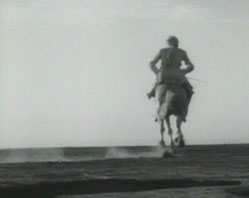 (I still recall the long shot of a lone rider approaching in the distance, betokened by the dust-cloud kicked up by his mount), and it shows that dealing with "extremely compromised and damaged materials" does not necessitate going the digital route. Yes, the soundtrack was digitized, as is pretty much unavoidable these days, but let us acknowledge the image's primacy and forgive this little transgression.
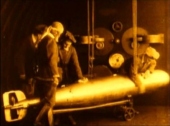 SFIFF's program claims that the print of 20,000 Leagues Under the Sea (d: Stuart Patton) they'll be running is struck from a nitrate negative at UCLA. To be more precise, it was struck from an internegative made in 1991 from UCLA's nitrate print. But nit-picking aside, the fact remains that what we will see has been derived, analog all the way, from the best surviving elements on this film, and should not be missed. Deep-voiced Stephin Merritt of Magnetic Fields fame will, with a little help from his friends, provide the modern-pop accompaniment.
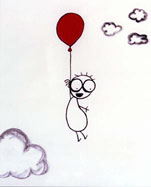 To again quote SFIFF's program notes, Don Hertzfeldt "eschews digital cameras for an anachronistic 35mm animation setup". I wouldn't have used the word "anachronistic", but I am glad he's still working in the blessed medium. Hertzfeldt's work, with its primitivistic stickman style, isn't characterized so much by build-up and pay-off as by the constancy of his keenly cynical observation of human foibles. My last experience of his work was a disheartening Spike and Mike's Sick and Twisted program that ran from DVD (or some similar video source) and led me to despair of ever again seeing new animation done on film. I'm not sure if it's a revival, strictly speaking, but this tribute will include 35mm prints of Billy's Balloon, Everything Will Be OK, I Am So Proud of You, Intermission in the Third Dimension, The Meaning of Life, and Rejected, some of these perhaps making their Bay Area on-film debuts. Missing, apparently, is my favorite of his, the early Ah, l'Amour, which in two minutes provides perhaps cinema's most concise elaboration of the mating urge's pitfalls.
But let us cast a glance towards the future. Is there any hope still for hands-on, analog ways of working in film? The digital intermediate may reign supreme in Hollywood and among those who aspire to emulate its bland populist appeal, but in Iran, whose national cinema emerged onto the world-stage late last century and still, for the most part, retains its vitality and individuality, this is not the case. This may be a matter of necessity--the best-known Iranian director, Abbas Kiarostami, having achieved worldwide prominence, apparently felt secure enough in his means and his reputation to recently forswear film for video-origination on all future projects (let's hope this proclamation has all the force of a typical Hollywood promise)--perhaps Iran simply hasn't got the digital infrastructure to do otherwise.
The regrettable political climate demands that Iranian cinema stear largely clear of controversial themes, and as a result we find a recurrent focus on children's travails and on opaque allegories. Both of these modes, however, have been so masterfully and indiginously developed that (I say facilely as an outsider) one might easily regret any future liberalization on aesthetic grounds should it alter the unique course of the nation's cinema.
Sticking to traditional, essential, characteristic methods of filmmaking has had a similarly felicitous effect on Iran's cinema, one untarnished by association with political repression. Even as simple an effect as an optical dissolve is quite alien to this cinema, which privileges staged moments as captured by the camera, and as juxtaposed by simple editing.
Mohammad Rasoulof is rapidly becoming one of my favorite Iranian directors. His Iron Island, the best film I saw in 2006's festival, turned a hulking, sinking ship and its inhabitants into an allegorical social microcosm. The White Meadows, his entry this year, which I caught in a pre-screening, also forges of a succession of salt-encrusted islands on mist-shrouded Lake Urmia an obscurely allegorical space. The salt is everywhere. It is sorrow and sin, and the saline drops that issue from the eyes of the isolated islanders are collected by a mysterious boatman.
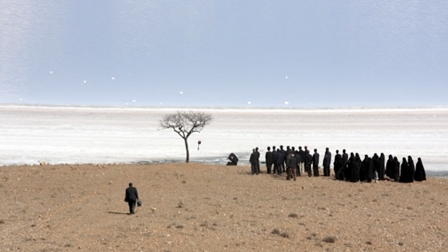 Pictorial tableaux of black figures on white ground abound in the photography by veteran cinematographer Ebrahim Ghafori (several films each by Mohsen Makhmalbaf, his wife Marzieh, and their daughter Samira), the general monochromaticity of these shots stemming from the landscape and the clothing themselves, not from desaturation in post-production. Editor Jafar Panahi is probably better known as a director himself, having made The White Balloon and numerous other films. A simple illustration from the film demonstrates their apt use of cinematic resources in solving a practical problem. A character must descend by rope into a well, but the "well" is obviously just a knee-high cylindrical construction obscuring the absence of a hole in the ground. After the man starts to climb into the "well", a herd of extras gathers to rubberneck, and in the next shot, our view is occluded, so we are not bothered by the slackness of the rope or the disappearance of the man. Cinema at its simplest.
If the rest of my festival selections are half as good as this one I'll be quite content.
Thanks to Mark Toscano, Paul Ginsburg, Dave Oakden, and Paul Tonta for providing restoration details.