|
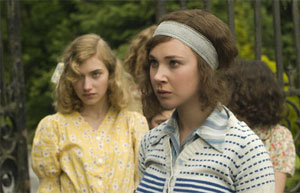
The first full day of festival programming yielded me only one screening, the pseudo-Iranian Frontier Blues. Director Babak Jalili was born there, but moved to England as a child. This film, a product of his residency at Cannes, overpowers its indigenous Iranian tendencies with internationalist exoticism. Jalili acknowledges his outsiderhood and even pokes fun at it in the character of a Tehran photographer coaxing Turkmen Steppe-dwellers to re-enact long-dead ethnographic archetypes.
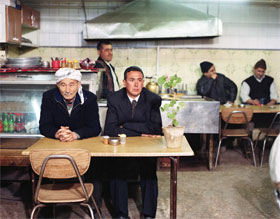 |
While titles and credits (both in English!) were done digitally, as was the soundtrack, I'm happy to report that no analog images were harmed in the making of this movie.
And on to Saturday...
Ounie Lecomte's A Brand New Life is the story of Jin-hee (remember this name), a 9-year-old Korean girl with a face only a jealous stepmother could hate.
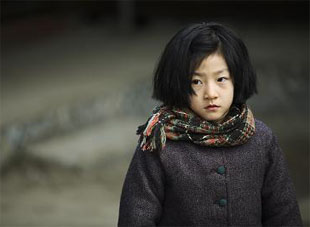 |
The videography is decent as videography goes--a bit bleary with blown-out highlights and shimmery shadows.
Like Frontier Blues, ABNL features a character, mischievous aspiring adoptee Sook-hee, practicing broken English--Anglophone audiences eat that stuff up. Sook-hee becomes Jin-hee's bosom buddy, and is also a delight to watch.
Perhaps I'm jaded to the point of cine-Asbergers, but it took the sobbing of the lady at my left for me to succumb to the prevailing emotions at film's end.
Pen-ek Ratanaruang (Last Life in the Universe) is back with Nymph, a mystical tale of infidelity set largely in an enchanted forest that seems close kin to those of Apichatpong Weerasethakul's Tropical Malady and Lars von Trier's Antichrist. In this fertile ground stands a stout and gnarled gothic cathedral of a tree, an object of fascination, by which men are consumed and passions consummated.
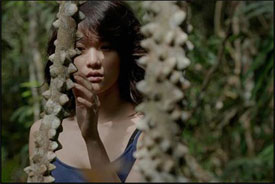 |
The sylvan photography (via digital intermediate) is very low-contrast, and the print shown had been through the wringer. Most interesting of the blemishes was the inscription "E10" hand-scratched onto several frames a couple minutes into each reel. Per Wikipedia:
E10, sometimes called gasohol, is a fuel mixture of 10% anhydrous ethanol and 90% gasoline that can be used in the internal combustion engines of most modern automobiles and light-duty vehicles without need for any modification on the engine or fuel system.
Somehow, I think this is the key to the whole film.
To conclude my second festival day, another Korean picture, Whang Cheol-Mean's Moscow. Jin-hee (remember that name? Just a coincidence; the timeframes don't work out),
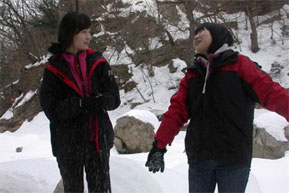 |
This was another digitally-shot effort, but a bright and colorful one, and the limited color depth frequently gave rise to a contour-map effect where one might expect to see gentle gradations, which I found not wholly unappealing. One shot, of an upset Ye-won's face swimming in a glowing sea of whiteness, was downright fetching.
But I do need to vet my selections a little better.