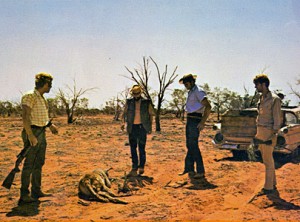
It's plausibly said of blaxploitation that, beyond its style and salaciousness, the genre in fact empowers blacks. Such a case for Aussie exploitation can't be made on the basis of this movie, in which every outback dweller is sleazy, vile, and dirty (and aggressively friendly), and the hero, a schoolteacher named John who at least initially rises above this animalistic morass, is an Englishman.
This Michael York soundalike, indentured to a one-room schoolhouse in Tiboonda, a whistlestop outpost, takes his Summer leave and heads to the nearby fictional city Bundanyabba to catch a plane for Sydney where awaits his girlfriend, who in her red swimsuit mantled with crashing waves provides, in brief cut-in shots, a thankful contrast to the sweaty, grimy visual texture of the outback. 'Yabba men are sociable types who don't take kindly to strangers declining a beer when it's offered. John encounters several strangers, and with each downed beer relaxes his disdain for their provincial boorishness.
|
As noted previously, this was a digital restoration, and it showed. The analog gods, however, had exacted their bitter revenge: for every digitally buffed-out blemish, sloppy projectionists had added several more. It was the worst of both worlds. My screening suffered what I presume was a brainwrap (a platter feed issue) in the third reel, causing an unplanned intermission.
 |
But to what does the title refer? A modest mountain can be seen as a backdrop in several shots, and indeed is the locus of the tone-setting opening scene. Since a movie must have a title, why not this?
I stuck around for Susa, the first feature by Georgian Rusudan Pirveli. She shot digitally and even I will allow that the result is quite lovely looking, with rich tones. Yes, the highlights are blown and there seem to be some time-based artifacts, but that's video being video, and honesty, in art as in life, is a virtue.
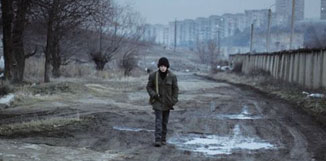 |
Bottles are a constant visual motif. Bottles of vodka, empty bottles, bottles smashed and stuffed into a cardboard roll to form a makeshift kaleidoscope through which some illusory beauty may be glimpsed in a cruel world.
Back to the Kabuki Thursday for a late show of Claire Denis's White Material. This is, I think, her third film set in Africa, whose emigrants have however featured prominently in others of her works. Here the situation is reversed, with Isabelle Huppert, her son, her ex-husband, and his father the only whites in an unnamed country (presumably Cameroon) beset by violent unrest.
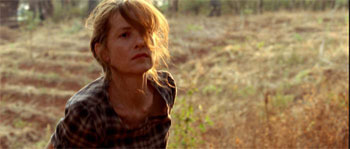 |
Denis has a wise, unromantic perspective on the world. She knows not everything is accessible to human understanding, and her films embrace this opacity. She doesn't go in for establishing shots. Instead, we see fragments of a jumbled timeline buttted one against another, getting acquainted, exchanging phone numbers.
I was less than thrilled with the standard release quality of the print, several harried generations from the camera negative, that sacred nexus of a film's formative forces. This remove was partly due to the choice to shoot a scope picture non-anamorphically, necessitating an extra optical step in the manufacturing of a release print. Perhaps also the scope lens in the Kabuki's large house is not the best--I noticed some chromatic aberrations.
Posted May 9, 2010 at 9:34pm by Jodie C. (unregistered):
Susa did look like a Culkin now that you mentioned it.