SFIFF 2010 Roundup, Part 3
Posted May 4, 2010 at 3:36am by Carl Martin, edited May 5, 2010 at 12:47am
I had wondered if I would see another festival film as good as The White Meadows, and I have: Le père de mes enfants (The Father of My Children). I skipped Mia Hansen-Løve's previous film Tout est pardonné (All Is Forgiven) in SFIFF 2008 but heard it was wonderful, so I was glad to have a chance to atone this year.
This is a film of consummate perfection, the most humanistic I've seen in the festival so far. Though it's fraught with complex emotions, not one rings false. The story concerns Grégoire, movie producer and head of an unsustainably ideal family. Their familial bliss, portrayed with utter naturalness, is threatened from without, and as these forces mount they lead to a rupture at once inevitable and deeply shocking. I was stunned with the aesthetic delight of its unexpected necessity. How the film thereafter navigates its changed waters elevates it from mere brilliance to masterpiece status.
Hansen-Løve is Olivier Assayas's protégé and lover, and she has made a film as good as the very best of her mentor's. She directs with confidence and delicacy, intuiting when scenes call for intense intimacy or respectful remove.
Alice de Lencquesaing et père dans The Father of My Children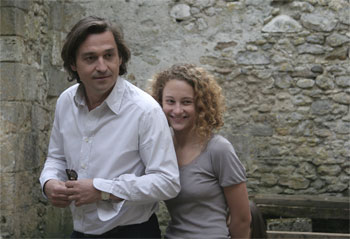 |
Special notice must be given actress Alice de Lencquesaing who plays Grégoire's eldest daughter Clémence (and who I assume to be the actor's real-life daughter). As in Assayas's L'heure d'été (Summer Hours), her emotive talents are formidably displayed, and her skin and frizzy hair show a great affinity for light.
This is a rare film (tangentially) about filmmaking (another is Irma Vep, also by Assayas) that has no scenes in which film is shot or sets are seen. But there are discussions of film's less romantic aspects, from financing to labwork, and these should deepen the casual cinephile's appreciation for the medium.
Speaking of labwork, I have nothing but praise for the parties involved in the production of the lovely print shown. Photography as fantastic as this deserves such a showcase.
Harold Torres y Sonia Couoh en Northless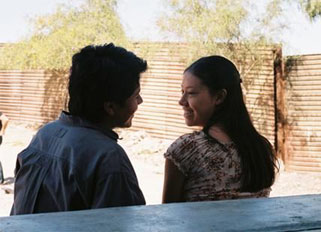 |
Taciturn Andres travels from Oaxaca, across the northern frontier and into the hands of the U.S. Border Patrol in the nearly wordless opening to Rigoberto Perezcano's Norteado (Northless). Bounced back to Tijuana, he takes in with the operators of a small grocery, biding his time until his next border run. For a time we know very little about this man--the film seems to strive against meaningfulness. But through Andres's halting romantic entanglements with two lady grocers--whose onsets closely parallel each other--we learn that all three have made families, and that these families are in various stages of dissolution due to the border's corrosive influence. But there are few other revelations in this minor if topical film.
Post-production was digital, the results unexceptional.
This film is also showing in the upcoming Hola México Film Festival.
Keeping up with the Gangulis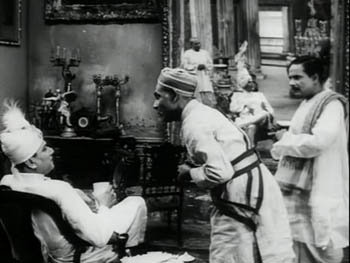 |
Satyajit Ray's Jalsaghar (The Music Room) is split fairly evenly into two halves. The first is a flashback chronicling the declining fortunes of landlord Biswambhar Roy as the rising river reclaims his lands and he contents himself to rest on the laurels of his forebears, a pattern that continues in the "present" of the second half. The tragic flaw that ultimately fells this already broken man is vanity: he empties his coffers to one-up his crassly industrious neighbor by hosting lavish concerts in his music room.
(These feature a number of important Indian musicians of the day, and a fantastic dance performance towards the end.)
In the film's poetics, insects and spiders march in the vanguard of creeping decay, while the capsizing of a small figurine presages a pivotal tragedy.
This analog restoration from the '90's doesn't attempt to go beyond what I consider to be the mandate of such work and plaster over scratches and such with a patchwork of conjectured image detail. As a result, "accretions of time" are quite evident in the finished product--but personally I'll take that over fakery.
I attended the presentation of The Mel Novikoff award to Roger Ebert not for the ceremony but to see the following film. But first came the obligatory encomia from Terry Zwigoff, Errol Morris, Jason Reitman, and Philip Kaufman. Zwigoff, after humorously dissing Ebert's wife Chaz, expressed his unsociability and disdain for movie audiences (with which I can sympathize) and his preference for home viewing (with which I cannot). Ebert, for his part, with his computerized voice synthesizer sounded less like Stephen Hawking than I thought he would, yet not really much like himself either. But on to the movie.
Tilda Swinton unmasked |
Erick Zonca has in Julia directed Tilda Swinton in a performance of Gena Rowlands-like body-and-soul commitment. Indeed, the setup and character arc recall a certain Cassavetes-directed vehicle for his wife. Julia is an alcoholic, a self-destructive wreck into whose netherward spiral gravitate numerous susceptible souls. Her facade of respectability shattered and her white-collar job out the window, she gets embroiled in a kidnapping plot that even on paper looks like a sure-fire disaster. Naturally things go wrong, but in unexpected ways, and as in Kurosawa's High and Low we take a journey into the depths of depravity and destitution. The kidnapee, a little boy who looks like he might grow up to be John C. Reilly, does touch off a spark of maternal instinct in Julia, but it burns waveringly and can hardly arrest her descent.
Like White Material, Julia is a scope ratio film shot spherically then squeezed optically in post-production. In this case gorgeously. The print was a bit scratched up, but made for a lovely viewing experience anyways.
Senso is, in theory, a sumptuous film. In this hyped restoration, however, I sensed the digital veil intervening between my tired eyes and Luchino Visconti's romantic melodrama. Such a shame.
A night at the opera with Alida and Farley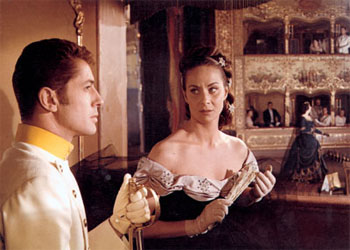 |
The setting is 19th century Austrian-occupied Venice. Effete imperial soldiers are everywhere in their beribboned pantsuits. Alida Valli, with her somewhat masculine features, plays Livia, an Italian contessa with the odious conviction that personal freedom ought subvert itself to "national freedom". She flirts with womanizing lieutenant Mahler (Farley Granger) to forestall a prospective duel between him and her cousin, a resistance fighter. But Mahler, as it happens, is something between a pacifist and a coward and had no intention of carrying through with the duel.
Nevertheless, the contessa falls in love with this Austrian soldier. Their tragic disparity comes down not to nationality but to her romantic fighting spirit and his self-serving apathy. The war that breaks out is mirrored on the intimate scale of their affair by abused affection and betrayal.