SFIFF 2010 Roundup, Part 4
Posted May 10, 2010 at 4:03am by Carl Martin, edited May 10, 2010 at 6:19pm
In my eagerness to catch all the Iranian films in the festival, I saw one great work (The White Meadows) and two lesser ones. I described Frontier Blues as pseudo-Iranian and I'll say the same of Tehroun. Director Nader Takmil Homayoun lives in Europe (France, I believe) and he shot his feature in Tehran on video, no doubt due to the non-coöperation of the authorities. I do admire the moxie it takes to shoot subversively, and while 16mm should be the go-to format for such endeavors, the unlikelihood of capturing usable sync-sound in an urban setting works against the typical qualities of Iranian cinema that I much admire.
Spare change?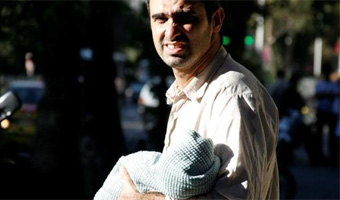 |
The deck thus stacked against him, this ex-pat has made a not wholly unsuccessful movie. Homayoun points up the distinction between the fronts put forth by his characters to gain advantage and the realities of their existence. In so doing he reveals some of the seedier truths about Iranian society. Ibrahim panhandles for a living but tells his pregnant absentee wife he's a shopkeeper. To engineer the sympathy on which his "job" depends he brings along a rented baby and a made-up sob story. The wife is practicing her own deception (the nature of which was unclear to me--it seemed to involve smuggling beef jerky). A prostitute dresses as a schoolgirl to gain possession of the rent-a-baby, intending to sell it. The aggregate of all these deceptions is of course chaos and misery.
The film is not yet a year old, yet this print had clearly made the rounds. Presumably it was residue from lousy splicing tape or some other foreign adherend causing a platter feed failure that led to the film's jumping out of frame, burning on screen, and pulling the projector out of alignment near the end of the third reel. I couldn't stick around to listen to much of the director's Q&A (for which the presentation of the credits was compromised) afterward, so I don't know if he was in the room at the time.
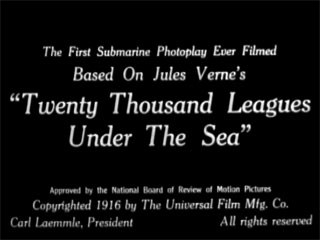 Stephin Merritt drew a large crowd for his scoring of Stuart Paton's Twenty Thousand Leagues Under the Sea. (I wonder if the renegade flash photographer was ever caught?) This is one of those silents whose every reel starts with an iteration of the title card (lest we forget that this is "The first submarine photoplay ever filmed"), and for Merritt this was an opportunity to play (and sing) his catchy main theme eight times. At other times he would produce ambient environmental soundscapes, or provide invented Popeye-style mumbled dialog that mostly kept to the spirit of the scenes. The success of this strategy was only undercut by the odd misguided falsetto female part, and even so the "I don't want to wear pants" number was a winner.
Eight arms under the sea |
The 1916 film, perched on the cusp of dramatic narrative's ascendancy as cinema's primary form, harkens back to earlier (but to this day still extant) modes of spectacle, as in the extended sequences of murky underwater vistas. As drama, the story is oddly constructed, following spectacle with payoff before attending to the setup (Verne, we are told, left this bit out). It might be mistaken for the sort of narrative experimentation that would only come about much later with the arrival of the various "new waves".
Asia Crippa in La pivellina: it's all downhill from here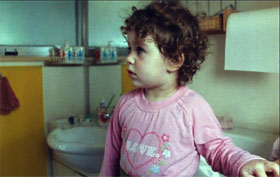 |
Wednesday, as it turned out, was my last festival day. Exhausted after another night of abbreviated sleep and three non-festival films, I couldn't make it through Tizzi Cova's and Rainer Frimmel's La pivellina without nodding. I think it was a pretty good film, what I saw of it. A lady with loudly-dyed hair finds a seemingly abandoned toddler on a swing and takes it home as one might a puppy. Over the course of the film the child is integrated into the woman's loose family structure. All the performances have an improvisatory flavor, and even little Asia Crippa as the toddler acquits herself quite endearingly, if unconsciously. The camerawork evokes the Dardenne Brothers as it follows characters in long takes, often from behind. It is, however, far shakier, and appears to be standard 16mm rather than the super-16 favored by the Dardennes.
I was glad for the rest, however, for the real reason I found myself at the PFA that night was A Religiosa Portuguesa (The Portuguese Nun) by American transplant Eugène Green. As Susan Oxtoby hinted in her intro, Green is heavily indebted to Manoel de Oliveira, particularly in his attention to conversation and the particular sonorities of different languages, and to Robert Bresson (filtered through de Oliveira) in his direction of actors. Several de Oliveira regulars appear, including the lovely Leonor Baldaque as a French-Portuguese actress arrived in Lisbon to shoot a film about a love-struck nun.
The penetrating gaze of Leonor Baldaque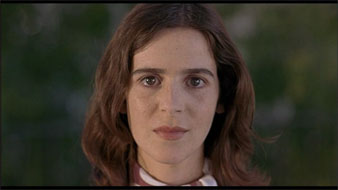 |
This is a film of deliberate gestures from actors and camera alike, though unlike with Bresson there is room for the odd emotive moment. Characters gaze fixedly while speaking and focus pulls clarify delirious blurs of night light into the skyline of Lisbon, to which this film is in some measure a love poem. Romantic or erotic love is, even among the living, here sidestepped in favor of its spiritual manifestation, and the beauty of the film will not allow us to dismiss such a quaint sentiment.
Like The Father of My Children, this film kind-of about filmmaking respects the sanctity of its photographic medium, bypassing the nowadays near-ubiquitous digital pipeline to give us transcendently beautiful imagery in all its analog splendor. (I'll note the obvious: that the images in this blog have been digitized and thus can't properly illustrate this distinction, so central to FOFF's mission.)