The Screen Scene: I Wake Up Dreaming--2011: The Legendary and the Lost!
Posted May 12, 2011 at 4:19am by Carl Martin
Elliot Lavine is back with another killer two weeks of noirish double features at the Roxie, all but one show being in 35mm or 16mm.
Sunday, May 15's films feature a supernatural theme... whether a product of flim-flam or not, you'll have to find out for yourself.
In The Spiritualist, a seaside villa houses two sisters (one of them They Live By Night's Cathy O'Donnell) seduced by Turhan Bey's occult powers. A séance-summoned figure from their past threatens to upend the romantic possibilities of the present. A wonderfully gothic atmosphere is maintained by John Alton's photography, which incorporates several of his trademark "looking up through something" shots.
Edward G. Robinson: his hands are tied |
Night Has a Thousand Eyes features Edward G. Robinson as a sideshow clairvoyant who seems to be cursed with a genuine prescience. When it comes to interfering with fate's course, he is impotent, and therefore a perfect noir hero. John Farrow's brisk direction keeps the concept fresh and the twist ending manages to surprise without betraying the film's conceits.
If Robinson is a man who knows too much, Burgess Meredith knows too little in Street of Chance, showing a day earlier. Freak-accident-induced amnesia leaves him with no recall of the last year, one that apparently saw major changes in his life. Reconstructing this void will inevitably lead to a shocking revelation--that is, unless the script chickens out at the end.
Oh, that kind of horse! |
On May 21, the amazing and curiously-titled Ride the Pink Horse ought not be missed. Robert Montgomery directs and stars, and holy cow, what a glorious, demented presence! This Russell Metty-photographed, Ben Hecht-scripted picture maintains a perverse edge throughout--kind of in the Kiss Me Deadly (showing on May 26) vein--as Montgomery tears through a New Mexico town hellbent until his bluster and bravado run out. He treats everyone else like dirt, particularly the women (is there a toned-down gay subtext here?) and navajos. Look out for a rogues' gallery of familiar noir faces in this gem.
Rounding out this double-bill, I Love Trouble has Franchot Tone investigating the colorful past of a businessman's wife. Every lead seems to make the case more complicated--as Jeff Lebowski would say, "lots of ins, lots of outs"--and Tone very nearly gets ensnared in its convolutions. And then it all gets wrapped up in one of those rushed Agatha Christie-like explications, quite satisfactorily, as it happens.
Next day, Edmond O'Brien does his best shlubby Bogart impression as a conscientious small-potato lawyer hired for protection, under false pretenses, by smarmy big-cheese attorney Vincent Price in The Web. Their destinies linked, O'Brien courts his own downfall to expose his boss. This classic noir setup--a man damned by his own scruples--fails in this case to produce a masterpiece, but it's worthwhile nevertheless.
The unquestionable double-feature-not-to-be-missed of the year is May 23's pairing of ultra-cheapo obscurities The Violent Years and Dancehall Racket (the common link here being actor Timothy Farrell, I suppose).
You're not supposed to be turned on by this. |
The Violent Years makes a good argument for the proposition that an Ed Wood script directs itself. In addition to Wood's risible dialogue, we have awkward line deliveries, bad pacing, stodgy blocking, and general incompetence. But the receptive might find here a hint of demented genius as well. Take the cutting. When several simultaneous actions within a scene are intercut, we nevertheless often see the entirety of these actions, as if no time were lost in cutting away. Is this an attempt to maximize the footage used in this not-quite-an-hour feature, or is it a radical disruption of the relentless linearity of attention imposed by a film's soundtrack? Also, the photography is noteworthy for its sheer competence.
At any rate, Wood was clearly eager to grind the axe of social responsibility, and this film will certainly satisfy anyone's appetite for '50's American-style eugenics, as it excoriates permissive parents who unintentially foment juvenile delinquency and play into the hands of "foreign" interests intent on bringing down our way of life. Much sermonizing is directed towards the parents out there, and the kids depicted--a girl gang that rapes (!) and robs for kicks, because they can--are given no psychological depth whatever.
Getting heavy-handed with Lenny Bruce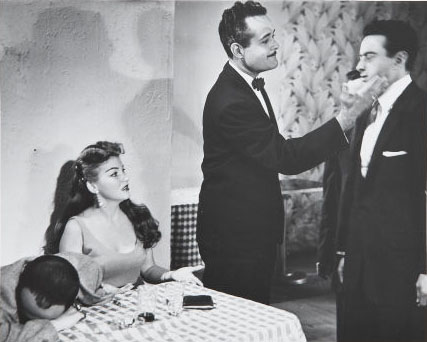 |
If Wood's sincere but misguided do-gooderism wrongheadedly courts the approval of authorities, Lenny Bruce's utterly demented Dancehall Racket (directed by the notorious Phil Tucker of Robot Monster f(sh)ame) spits in their faces. No Production Code Seal graces this tawdry debut from writer-star Bruce. An air of subversive somnambulance pervades the film, from its mocking newsdesk framing device to the antics on display in the smuggling racket fronting as a dime-a-dance joint, in itself the closest thing to a brothel you'll see in a movie of this era. The whole cast seems in on the gag, having a great time thumbing their noses at decency and convention. Even Lenny's wife and mother participate, the latter doing a show-stopping Charleston. Lenny himself has that jarring I-don't-give-a-shit presence of Timothy Carey. Had he only been based in Europe Bruce could have been a Godard or a Fassbinder. As it is, he certainly achieved legend status, but not as a filmmaker.
Also not to be missed, if you've never seen them before: Elisha Cook Jr. as a jazz drummer in Phantom Lady, Fritz Lang's Ministry of Fear, Cell 2455, Death Row, preceded by a wonderful (and very of-its-time) short, Justice and Caryl Chessman, from the FOFF collection, Barbara Stanwyck in Witness to Murder, and of course the great Kiss Me Deadly. But don't disregard those 16mm rareties either: when else are you going to see C-Man or The Great Flamarion?