|
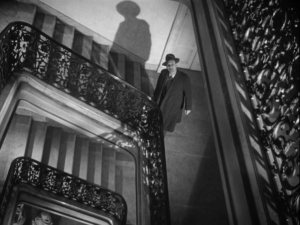
Carol Reed's archetypal Brit-noir features an international cast of Americans (Joseph Cotten, Orson Welles), Limeys (Trevor Howard, Bernard Lee), Italians (Alida Valli), Germans (Ernst Deutsch), Austro-Hungarians (Paul Hörbiger), and Dutch tilts, which, along with long shadows and Wellesian low angles, lend the film its defining expressionistic aesthetic.
Cotten's naive Holly Martins, summoned to Vienna at the behest of old school chum Harry Lime, arrives in time for his would-be host's funeral, the details of his death suspiciously inconsistent. Occupation policeman Major Calloway paints Lime as a no-goodnik, and Martins decides to stay on to clear the air.
Making the acquaintance of Lime's erstwhile associates and his girl, Martins treads lightly in his friend's still-warm footprints. Will he succumb to the vortex pull of Lime's seductive amorality, find his moorings with cynically law-and-order Calloway, or tread water somewhere in between?
My late-90's-vintage memory paints the film in somewhat more sparkling silver tones than what I witnessed this time around.
 |
Famously pitting anoracked mods against leather-bound rockers on the shores of Brighton, the film drew to the Castro a third contingent, mockers: cine-hooligans bent on drowning out the soundtrack with their inanity. That, and less-than-perfect acoustics ensured that a fair portion of the film's working-class-accented dialog was quite unintelligible. But this is a visual film of raw emotion, and this came through a-plenty.
The reel ends were quite filthy and the first reel had a nasty splice in it, despite the claim that this print had screened only a few times previously.
Abrir puertas y ventanas (Back to Stay)
Or per the laser-subtitles, Open Doors, Open Windows--through which sensitive conversations reach unintended ears. Inversely, voicemails go unheard and notes unread: communication breakdown is a constant motif among three parasitically close sisters after their grandmother's death. Seasons pass discreetly in Milagros Mumenthaler's debut, and much of what transpires is perceived only by the wake left, leaving the viewer himself incommunicado, and while over time we can reconstruct certain events, some enigmas outlast the film's duration. Often that's how it goes.
The film derives its English title from a song played on the phonograph and then pointedly sung along to by the sisters, in one of those slightly anti-cinematic moments when one feels one is attending to lyrics rather than watching a film.
The focus at the top of the frame remained frustratingly soft (projection error) and yes, the film used a digital intermediate (production error), rendering the film in uninspired but not unwatchable hues.
L’hiver dernier (Last Winter)
A friend said she'd seen a screener of this one, and thought she might have cheated herself of the majesty of a 35mm print. If only! While the bright daylit scenes look OK, night shots, with their muddy digitized aura, predominate. This sort of ugliness cannot provide the invigorating spark necessary to support the glacial pace of the film, and the plight of the protagonist, an intransigent farmer, pales next to that of the audience.
 |
Whereas, say, Jennifer Westfeldt's rom-com genre bending seems ultimately to dead-end in an affirmation of convention, Daryl Wein's take here is genuinely refreshing, though backing that up would involve dropping a spoiler, so you'll just have to take my word.
 |
The film's first movement follows the social lives of the members of an anti-terrorism unit. Amidst plentiful expressions of machismo, we come to learn that the group faces trial for an over-aggressive action that left collateral damage, and that one of their number will most likely take the fall. This, however, is only a minor narrative point, and the next movement introduces a whole new group of characters, another social stratum in an emergent indictment of Israel's national soul.
We live in an age of such multiplex-pandering that an Academy-ratio movie simply can't be released properly, utilizing the full real estate available on a strip of 35mm film. The kludge of printing the image centered within the already-cropped contours of a widescreen format got plenty of shot-for-TV documentaries into movie theaters. Recently we've seen the practice extended to arthouse fodder like Meek's Cutoff and The Artist, and now Andrea Arnold's latest.
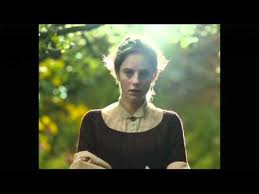 |
It's a damn shame, as in all other respects this is an excellent film, whose photography (Robbie Ryan) and cutting (Nicolas Chaudeurge) situate it squarely in the luminous orbit of Terrence Malick and Claire Denis (and Jane Campion?). As such it's a significant departure from William Wyler's also excellent 1939 adaptation of the Emily Brontë novel. Notable also are the novel racial angle and the complete absence, until the very end, of a musical score.
And here we come full circle, back to the union politics of Harlan County U.S.A., only here we're in France and instead of a strike we see the union leadership acquiesce to the company's need to downsize. A lottery is held, administered by the settled and close-to-retirement-age Michel, who draws both his own name (resignedly) and that of young Christophe (a little less accepting of his fate). In constrast to Barbara Kopple's film, we see here that the workers' interests can't be conveniently lumped together, and worker turns against worker in a shocking criminal act.
The film is less successful at assaying human behavior. There's simply too much implausible niceness here, and, for balance I suppose, some implausible churlishness as well. Human emotions can certainly be erratic, but at a certain point characters lose their humanity and become poorly conceived constructs. The screenwriter took questions afterwards but I had to catch the last BART train home so I don't know if the rest of the audience felt as I did.
The film was blown up digitally to 35mm after being shot in Super-16, resulting in a 1:1.85 ratio image, rather than the more common (for French films) 1:1.66.